Can you hydroseed St. Augustine grass?
No. The seed is not commercially available, and seedlings die in testing. Here is the UF/IFAS science and the realistic options for a Pensacola lawn.
No. UF/IFAS says St. Augustinegrass is not available in seed and is planted only as sod, plugs or sprigs. In testing described by UF/IFAS Okaloosa County Extension, the best germination reached about 40 percent, and every seedling then died of disease. For a St. Augustine lawn, lay sod or plugs. For hydroseeding, choose bahia, centipede or bermuda.
- Sold as seed
- No (UF/IFAS)
- Best germination in testing
- About 40 percent
- Seedling survival in testing
- None; all died of disease
- Ways to plant it
- Sod, plugs or sprigs
What UF/IFAS says
The University of Florida is unambiguous. Its turfgrass selection guide lists St. Augustinegrass as "not available in seed," to be planted as sod, plugs or sprigs. The UF/FDOT roadside guide repeats the point: "Unlike the other turfgrasses, St. Augustinegrass can be established only through sodding, sprigging, or plugging."
That puts it in the same category as seashore paspalum, which also establishes only from sod, sprigs or plugs. Neither grass belongs in a hydroseed tank, no matter what a flyer says.
Why the seed fails
Larry Williams of UF/IFAS Okaloosa County Extension has explained the biology for Panhandle homeowners. St. Augustinegrass produces seed with extremely low viability and germination, and the seedlings that do emerge are highly vulnerable to disease.
In the testing he described, about 40 percent germination was the best achieved, and 100 percent of those seedlings were killed by diseases such as gray leaf spot. Gray leaf spot thrives in warm, humid weather, which is exactly what a Pensacola summer delivers.
That is why no reputable seed supply exists for it. The grass you see in Florida lawns was grown from vegetative pieces on a sod farm.
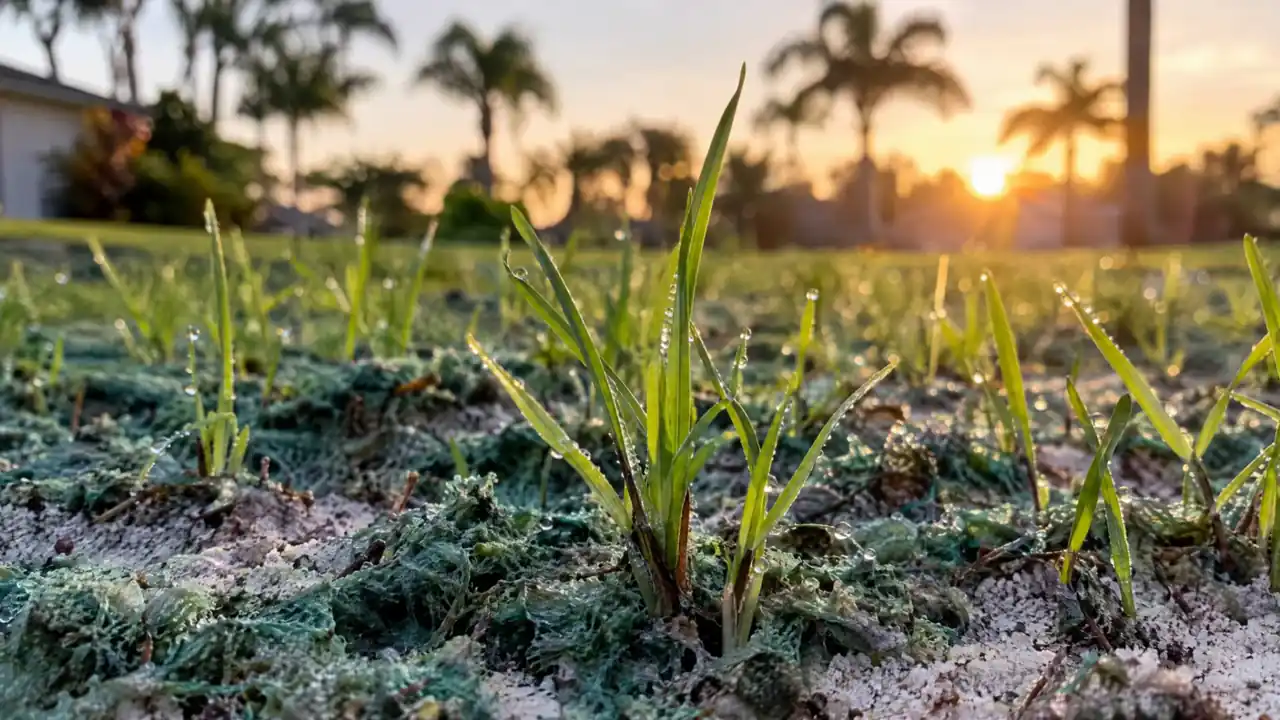
If someone offers to hydroseed St. Augustine, walk away
A slurry sold as St. Augustine either holds a different grass or will not establish. Ask to see the seed tag and the species printed on it before work starts.
Option one: keep St. Augustine and lay sod or plugs
If you want St. Augustine's broad blades and shade tolerance, install it the way it grows. Sod gives instant cover; plugs cost less but take longer to knit together. SodCalculator lists St. Augustine sod material in Florida at about $0.50 to $0.90 per square foot before installation.
St. Augustine is a strong coastal choice. UF/IFAS rates its salt tolerance good, and UF/IFAS Gardening Solutions names it, with zoysia, among "the best choices for homeowners" near the coast, while noting that salt-tolerant grasses still "can't be irrigated with saltwater." Our hydroseeding vs. sod comparison covers when sod makes more sense.
Option two: hydroseed a grass that grows from seed
If cost or acreage points you toward seed, change the grass, not the method:
- Inland lawns: centipedegrass, which UF/IFAS calls "the most common home lawn grass in the Florida Panhandle," or Pensacola bahiagrass for larger, lower-maintenance lots.
- Sunny, high-traffic or coastal utility areas: common bermudagrass, which the UF/FDOT guide recommends for sandy, saline soils.
Plan the switch for spring. UF/IFAS seeds centipede at about 4 oz per 1,000 sq ft from April to July, and germination can take 2 to 3 weeks, with 6 to 8 more to establish. The Pensacola grass guide compares every option.
Coastal lots need a different shortlist
Near the Gulf and the sounds, salt narrows the options before seed versus sod even comes up. UF/IFAS rates salt tolerance as very poor for bahia, poor for centipede, good for St. Augustine, zoysia and bermuda, and excellent for seashore paspalum. Of the grasses rated good or better, only common bermuda can realistically be hydroseeded.
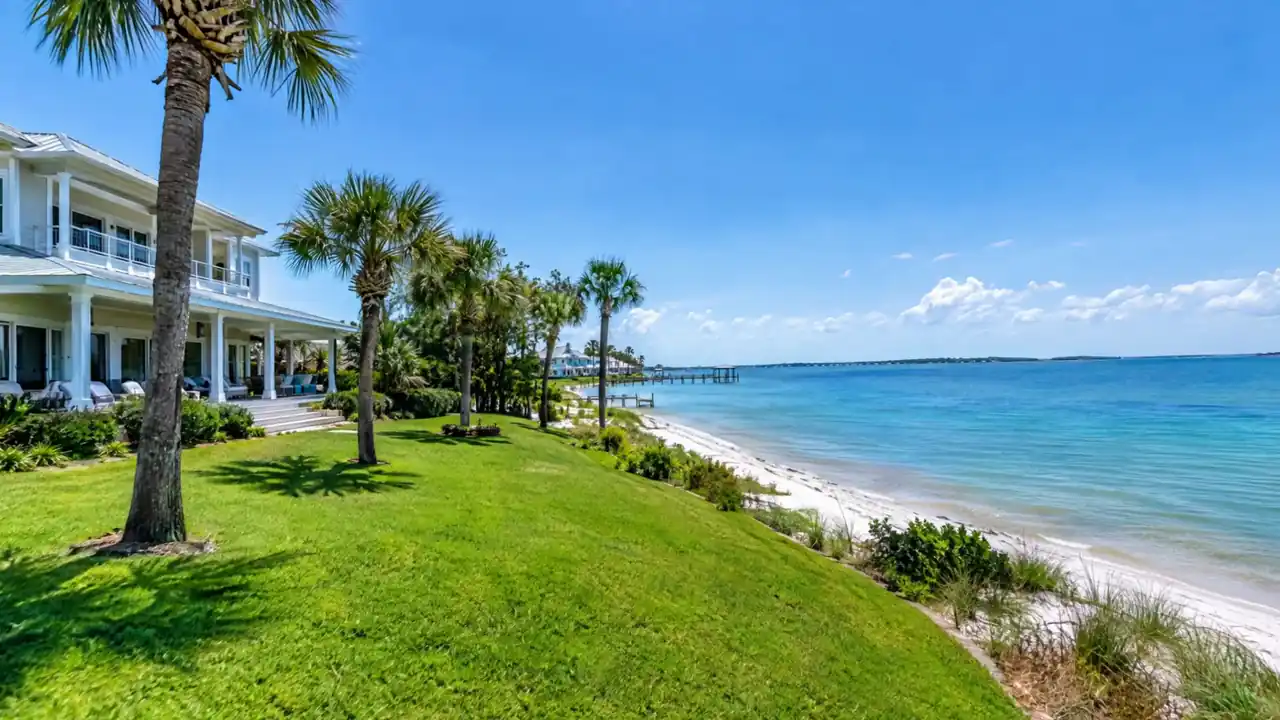
On Pensacola Beach, Perdido Key and the sound side of Gulf Breeze and Navarre, that usually means sodded St. Augustine or zoysia for the lawn and seeded bermuda for utility areas, swales and open ground. We do not promise bahia or centipede on salt-exposed beachfront. Dunes are another matter: planting seaward of the Coastal Construction Control Line can need a DEP permit, and dunes are restored with native plants such as sea oats, not turf.
Mixing methods on one property
Many lots do not need one answer. A common approach is to sod the front yard or shaded areas in St. Augustine and hydroseed side yards, back acreage, swales or a septic mound in bahia or centipede. The sod carries the look; the seed covers ground at a fraction of the cost.
Timing can split too. When the warm-season seeding window has closed, sod can go in for the visible areas while bare ground elsewhere is held with hydromulch until spring. We plan that mix during a site visit, or see our residential hydroseeding service.
Common questions about can you hydroseed st. augustine grass? the science
Short, sourced answers to what people ask us most. If your site has a wrinkle these do not cover, send it through the quote form below and we will talk it through with you.
Is there such a thing as St. Augustine grass seed?
Not as a reliable product. UF/IFAS says St. Augustinegrass is not available in seed and is planted as sod, plugs or sprigs. Any product marketed as St. Augustine seed should be treated with suspicion. Check the label for the actual species, because blends sold for St. Augustine areas typically contain a different grass.
Why can't St. Augustine be grown from seed?
Its seed has extremely low viability and germination, and seedlings are very vulnerable to disease. According to Larry Williams of UF/IFAS Okaloosa County Extension, the best germination achieved in testing was about 40 percent, and every one of those seedlings was then killed by diseases such as gray leaf spot.
What grass can be hydroseeded instead of St. Augustine in Pensacola?
Centipedegrass is the closest everyday substitute for inland home lawns and is the most common lawn grass in the Florida Panhandle, per UF/IFAS. Bahiagrass suits larger, lower-maintenance lots. Common bermudagrass is the seeded choice for sunny, high-traffic or salt-exposed utility areas. None looks exactly like St. Augustine, which is sold only as sod, plugs or sprigs.
Is St. Augustine a good grass near the beach in Pensacola?
Yes, for home lawns. UF/IFAS rates its salt tolerance good, and UF/IFAS Gardening Solutions lists St. Augustine and zoysia as the best choices for coastal homeowners. It must be installed as sod or plugs, and salt-tolerant grasses still cannot be irrigated with saltwater. Dunes themselves are restored with native plants, not turf.
How much does St. Augustine sod cost compared with hydroseed?
SodCalculator lists St. Augustine sod material in Florida at about $0.50 to $0.90 per square foot, before delivery and installation. Published hydroseeding ranges run about $0.06 to $0.20 per square foot nationally. The two are not interchangeable, though: hydroseeding means choosing a different grass, such as centipede, bahia or bermuda.
What happens if a contractor sprays a 'St. Augustine' hydroseed mix?
Based on UF/IFAS findings, either the mix contains a different grass, or any St. Augustine seed in it will germinate poorly and the seedlings will not survive disease. Either way you pay for a lawn you did not order. Ask for the seed tag before work begins and confirm the species and germination rate printed on it.
Keep reading
Related guides and services for sandy soil, heavy rain and the grasses that hold on the Gulf Coast, each written for Escambia and Santa Rosa county sites.
Hydroseeding guides
Plan the project, choose grass and care for new growth.
Open
Hydroseeding vs. sod: an honest comparison
Seed costs less and suits big, open or sloped ground. Sod is instant and the only route to St. Augustine. Here is how to decide on local sites.
Open
Best grass for Pensacola: hydroseeding grass guide
Seven turf grasses and two temporary covers, compared on the traits that matter in Escambia and Santa Rosa sand, salt and summer heat.
OpenPensacola bahiagrass: history, seeding and care
Found near the Pensacola docks and now planted across millions of Southeastern acres, it remains the toughest low-input grass for local sandy ground.
OpenResidential Hydroseeding
New-build lots and thinning lawns, seeded with a grass that suits deep Panhandle sand, in the months when it will actually take.
Open
Request a quote
Tell us about the site and we will quote the mix and method that fit it.
OpenSources
Facts on this page come from public sources, mostly UF/IFAS Extension, the Florida Department of Environmental Protection, FDOT and NOAA. We recheck them whenever we update the page.
- UF/IFAS EDIS LH005, Selecting a Turfgrass for Florida Lawns
- Larry Williams, UF/IFAS Okaloosa: St. Augustinegrass seed is not reliable
- UF/FDOT, A Guide for Roadside Vegetation Management (2012)
- UF/IFAS Gardening Solutions: Salt-Tolerant Lawngrasses
- UF/IFAS EDIS LH009, Centipedegrass for Florida Lawns
- SodCalculator: Florida sod cost
- HomeAdvisor: Hydroseeding prices
- Florida DEP: CCCL Dune Planting Recommendations
Tell us about the ground
Send the address and what you are trying to grow or hold in place. We look at the site, the soil and the slope, then quote the mix and the method that fit it.