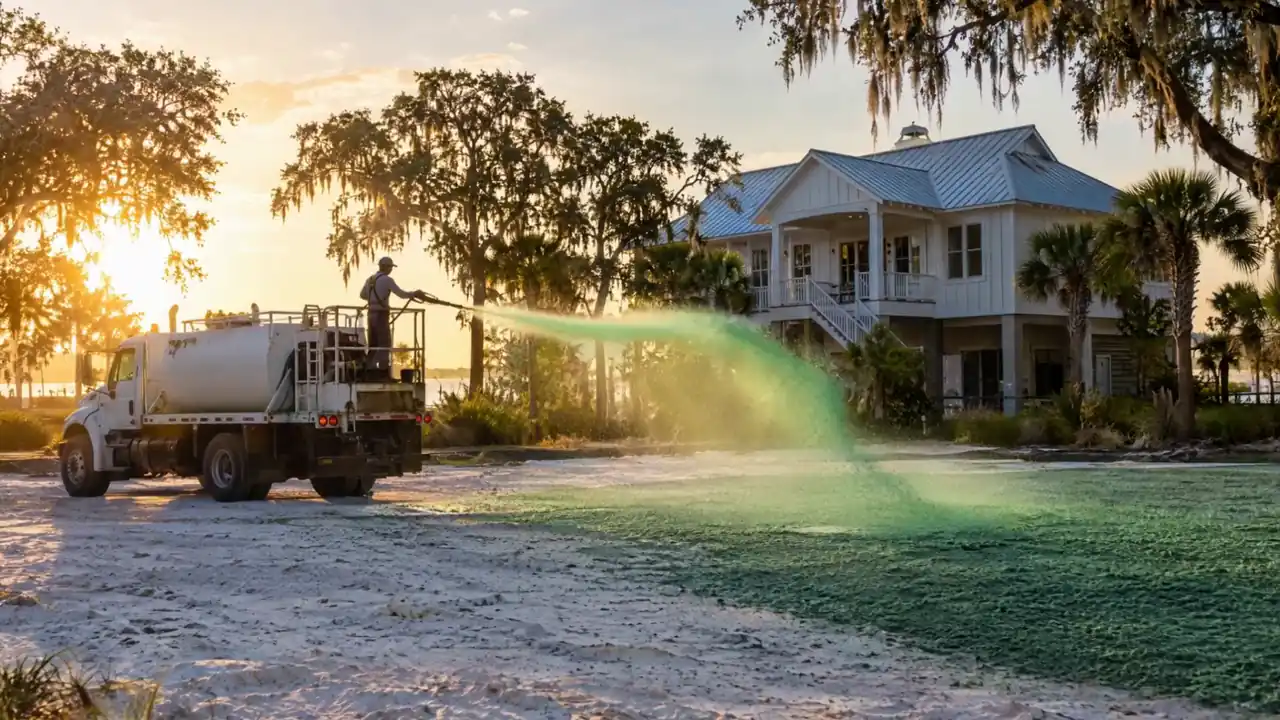
How much does hydroseeding cost in Pensacola?
Published local and national ranges, what they leave out, and the site conditions that push a Pensacola job up or down the scale.

A Pensacola cost guide from Homeyou puts hydroseeding at about $0.15 to $0.18 per square foot for 2,000 to 10,000 sq ft, and $0.13 to $0.15 for larger areas up to an acre. National guides range from $0.06 to $0.20. Soil prep, slope, grass choice, erosion products, access and watering move a job within those ranges.
- Pensacola, 2,000 to 10,000 sq ft
- $0.15 to $0.18 per sq ft (Homeyou)
- Pensacola, up to about an acre
- $0.13 to $0.15 per sq ft (Homeyou)
- National, per acre
- $2,600 to $8,700 (HomeAdvisor)
- Installed sod, national
- $0.35 to $0.85+ per sq ft
What published cost guides report
The most specific public figure for this market is the Homeyou cost guide for Pensacola, updated July 22, 2026. It reports $0.15 to $0.18 per square foot for jobs between 2,000 and 10,000 sq ft, and $0.13 to $0.15 per square foot from 10,000 sq ft up to about an acre (43,500 sq ft). The same guide describes a minimum charge of $131 to $1,042 and a 5,500 sq ft lawn at about $990.
National guides land in a similar band. Lawn Love reports $0.10 to $0.19 per square foot, or about $4,356 to $8,276 per acre. HomeAdvisor reports $0.06 to $0.20 per square foot, a typical project of $650 to $2,200, and $2,600 to $8,700 per acre.
Treat all of these as aggregator benchmarks, not quotes. They blend easy flat lots with hard ones and rarely say whether grading, soil amendments or erosion products are included. Their best use is a sanity check: is a proposal in the right range, and what does it actually cover?
| Method | Reported range | Source |
|---|---|---|
| Hydroseeding, Pensacola, 2,000 to 10,000 sq ft | $0.15 to $0.18 per sq ft | Homeyou Pensacola cost guide |
| Hydroseeding, Pensacola, 10,000 to 43,500 sq ft | $0.13 to $0.15 per sq ft | Homeyou Pensacola cost guide |
| Hydroseeding, national | $0.06 to $0.20 per sq ft; $2,600 to $8,700 per acre | HomeAdvisor |
| Hydroseeding, national | $0.10 to $0.19 per sq ft; $4,356 to $8,276 per acre | Lawn Love |
| Broadcast seeding, national | $0.10 to $0.20 per sq ft | HomeAdvisor |
| Sod, installed, national | $0.35 to $0.85 per sq ft | HomeAdvisor |
| Sod, material only, Florida | $0.30 to $0.95 per sq ft depending on grass | SodCalculator |
| Erosion control blankets, material only | About $0.35 to $1.05 per sq yd | Stormwater magazine |
Soil preparation moves the price more than seed
On most Pensacola lots the spray is the smaller part of the work. The seedbed underneath decides whether grass takes. UF/IFAS turf specialist Laurie Trenholm puts it plainly: "The most important factor is how well the ground is prepped prior to sodding or seeding."
Prep on a new-construction lot can include:
- Removing construction debris, rock and concrete washout
- Rough and fine grading so water sheets off instead of cutting channels
- Loosening subsoil compacted by equipment and deliveries
- Lime or other amendments when a soil test calls for them
A lot that needs only a light rake costs far less per square foot than one that needs regrading. Local ground conditions are covered in our guide to hydroseeding sandy soil.
Slopes, rain and erosion products
Pensacola averages 68.31 inches of rain a year (1991 to 2020 normal), according to the Florida Climate Center, with June through September the wettest stretch. On flat ground a standard hydromulch holds seed in place. Slopes, ditches and pond banks often need a heavier product, and that changes the price.
- Bonded fiber matrix (BFM) goes on far heavier than standard hydromulch, roughly 3,000 to 4,000 lb per acre on moderate slopes according to Stormwater magazine, and costs more per acre. No reliable public per-acre price exists, so it is quoted job by job. See bonded fiber matrix.
- Erosion control blankets run, for material alone, about $0.35 to $0.50 per square yard for single-net straw, $0.50 to $0.80 for wood fiber and $0.80 to $1.05 for double-net coir, per Stormwater magazine, before labor and staking.
Commercial sites under a stormwater permit may also need stabilization records for the SWPPP. Our erosion control page covers those options.
Price the finished lawn, not the spray
An application that washes into the street during a July storm is the most expensive one. Prep, mulch rate and timing decide whether the money turns into grass.
Grass choice, access and water
Seed rates vary widely by species. UF/IFAS lists lawn seeding rates of 5 to 10 lb per 1,000 sq ft for bahiagrass, 1 to 4 lb for bermudagrass and 0.25 to 1 lb for centipedegrass. Price per pound varies just as much, so the grass you choose changes material cost. Our Pensacola grass guide compares the options.
Access matters too. A truck parked beside an open area sprays faster than a crew dragging hose around a pool cage or down a steep backyard, so small, cut-up areas usually cost more per square foot than one open rectangle.
Finally, budget for water. A UF/IFAS extension agent calls establishing new turf "the single largest usage of water in the residential setting." In May, Pensacola's driest month at 3.90 inches, irrigation does most of the work.
How we quote a Pensacola site
We quote each site after a visit, because a per-square-foot number without one hides the parts of the job that matter. We measure the area, check slope, drainage and soil, and note truck access and the season. The written scope then states the grass mix, mulch or BFM rate, prep and any temporary cover, so you can compare it line by line against the ranges above.
Timing affects the scope as well. Seeding in the April to early July window usually needs only the permanent mix. Work in late summer or winter may add browntop millet or annual ryegrass as temporary cover, or a heavier mulch, to protect the soil until the permanent grass can establish.
If you are weighing seed against turf, read hydroseeding vs. sod, then request a site visit.
Common questions about hydroseeding cost: price ranges
Short, sourced answers to what people ask us most. If your site has a wrinkle these do not cover, send it through the quote form below and we will talk it through with you.
How much does it cost to hydroseed an acre in Florida?
National guides put hydroseeding at about $2,600 to $8,700 per acre (HomeAdvisor) or $4,356 to $8,276 per acre (Lawn Love). A Pensacola cost guide reports $0.13 to $0.15 per square foot for areas between 10,000 and 43,500 sq ft. Slopes that need bonded fiber matrix, heavy grading or temporary cover push large sites higher.
Is hydroseeding cheaper than sod in Pensacola?
Usually. Published hydroseeding ranges run about $0.06 to $0.20 per square foot, while HomeAdvisor lists installed sod at $0.35 to $0.85 per square foot and other guides report more. Sod gives cover the day it is laid. Hydroseed takes weeks to fill in and needs careful watering to get there.
Why do hydroseeding quotes vary so much?
Quotes differ mainly in what they include. Grading, debris removal, soil amendments, mulch rate, bonded fiber matrix on slopes, seed species and temporary cover all change the price. A low per-square-foot number that leaves out prep, or uses a light mulch rate on a slope, often fails in the first heavy rain.
Does the price of hydroseeding include watering?
Usually the installer applies the slurry and the property owner handles daily watering. UF/IFAS advises watering two or three times a day in small quantities for about two weeks for germination. Ask whether temporary irrigation, follow-up visits or touch-up seeding of thin spots are part of the scope before comparing prices.
Can I hydroseed my own lawn to save money?
HomeAdvisor lists hydroseeding equipment rental at about $300 to $500 a day. Renting saves labor but not seed, mulch, fertilizer or prep. Getting an even rate across fast-draining Pensacola sand takes practice, and an uneven application shows up weeks later as thin streaks that need reseeding.
Does bonded fiber matrix cost more than regular hydroseeding?
Yes. Bonded fiber matrix goes on far heavier than standard hydromulch, roughly 3,000 to 4,000 lb per acre on moderate slopes according to Stormwater magazine, so material and application cost more per acre. No reliable public price exists, so it is quoted per job. It is used where standard mulch would wash out: steep slopes, channels and pond banks.
Keep reading
Related guides and services for sandy soil, heavy rain and the grasses that hold on the Gulf Coast, each written for Escambia and Santa Rosa county sites.
Hydroseeding guides
Plan the project, choose grass and care for new growth.
Open
Hydroseeding vs. sod: an honest comparison
Seed costs less and suits big, open or sloped ground. Sod is instant and the only route to St. Augustine. Here is how to decide on local sites.
OpenResidential Hydroseeding
New-build lots and thinning lawns, seeded with a grass that suits deep Panhandle sand, in the months when it will actually take.
Open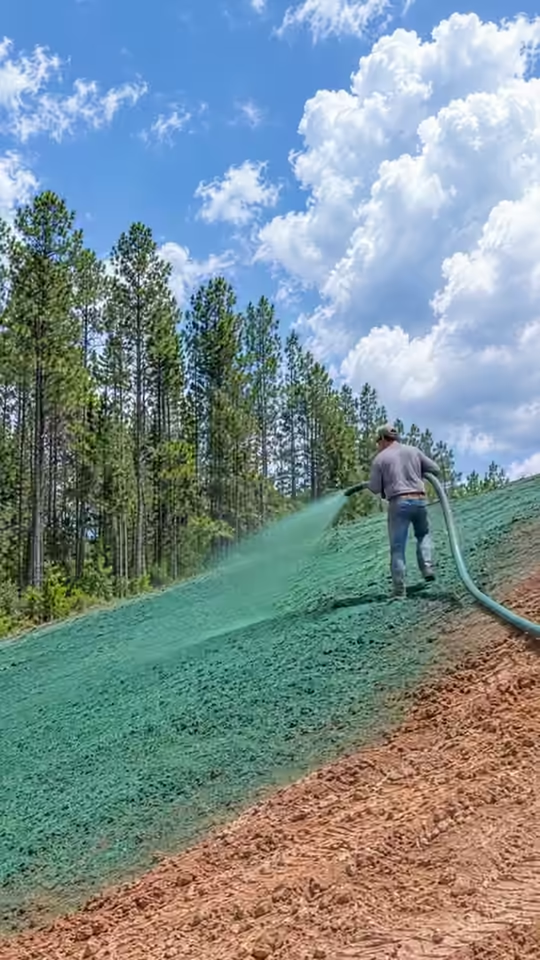
Bonded Fiber Matrix and Hydromulch
Sprayed erosion protection for slopes and bare ground: what BFM and hydromulch are, what FDOT requires of them, and when blankets are the better call.
OpenDoes hydroseeding work in sandy soil? Pensacola guide
Yes, when moisture and pH are managed. Local sands drain fast and hold little water or nutrient, so prep and early watering carry extra weight.
Open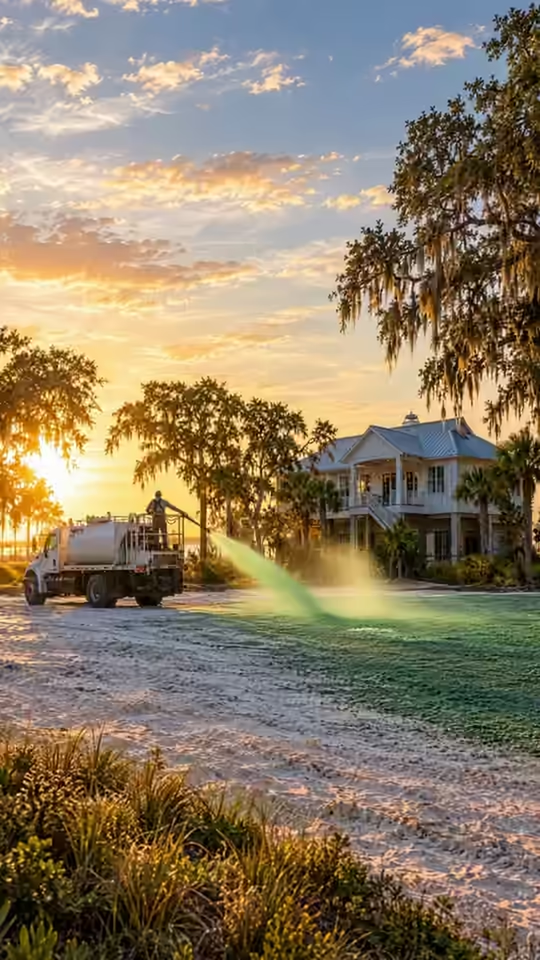
Request a quote
Tell us about the site and we will quote the mix and method that fit it.
OpenSources
Facts on this page come from public sources, mostly UF/IFAS Extension, the Florida Department of Environmental Protection, FDOT and NOAA. We recheck them whenever we update the page.
- Homeyou: Hydroseeding in Pensacola, FL costs
- Lawn Love: Hydroseeding cost
- HomeAdvisor: Hydroseeding prices
- SodCalculator: Florida sod cost
- Stormwater magazine: Cost-effective erosion control with blankets and mats
- UF/IFAS News: Summer sodding and lawn preparation (2020)
- UF/IFAS EDIS LH013, Establishing Your Florida Lawn
- Florida Climate Center: Pensacola 1991-2020 Normals
Tell us about the ground
Send the address and what you are trying to grow or hold in place. We look at the site, the soil and the slope, then quote the mix and the method that fit it.