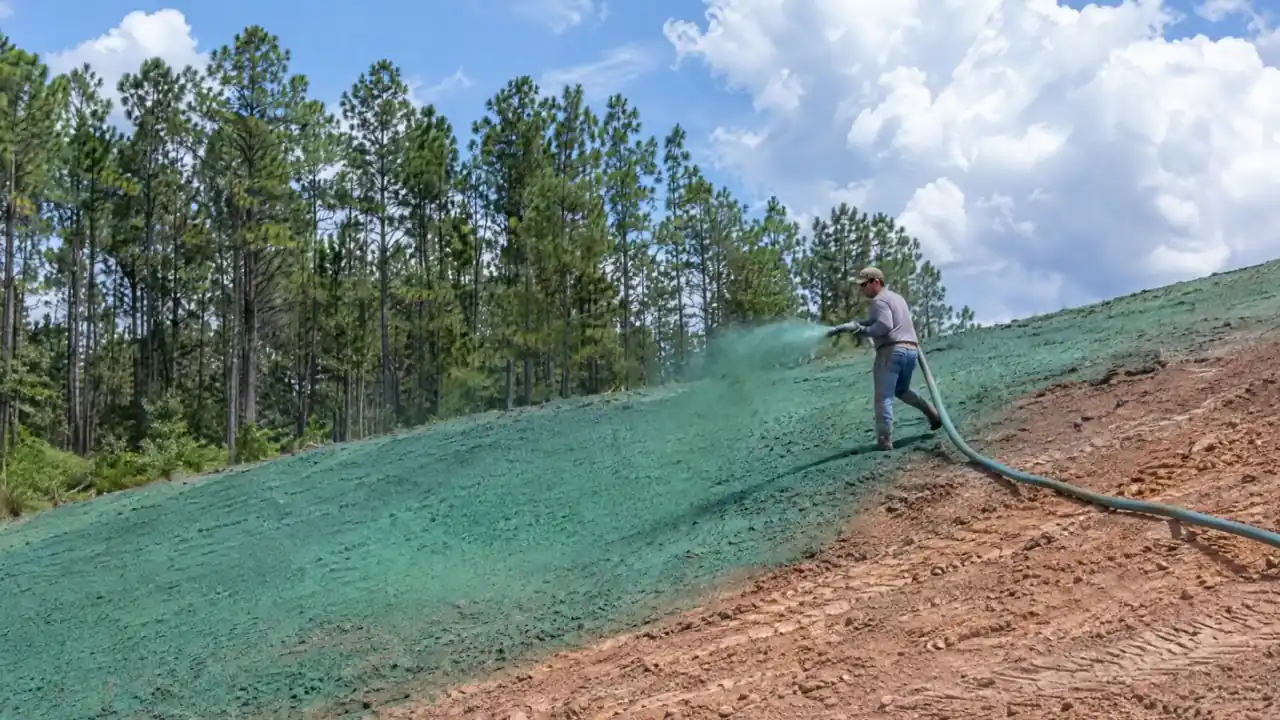
Bonded fiber matrix and hydromulch
Sprayed erosion protection for slopes and bare ground: what BFM and hydromulch are, what FDOT requires of them, and when blankets are the better call.

Bonded fiber matrix is a hydraulically applied erosion-control layer of fibers held together by a water-resistant bonding agent. Sprayed over seed, it forms a continuous blanket that resists rain on steeper, stable slopes. Hydromulch is a lighter hydraulic mulch for temporary cover or standard hydroseeding. FDOT Section 570 accepts BFM in place of seed, hydroseed or sod outside designated sod areas.
- BFM coverage (FDOT 570-3.5)
- 100%, no gaps
- When re-wetted
- Must not dissolve
- Biodegradability
- 100% biodegradable
- Allowed slopes
- Geotechnically stable only
- PAM in hydroseed (570-3.4)
- Anionic only, under 0.05% monomer
What BFM and hydromulch are
All three products start in the same tank. Hydroseed is a slurry of seed, mulch, fertilizer, tackifier and dye mixed in purpose-built equipment and sprayed evenly over the ground. Hydromulch is hydraulic mulch, with or without seed, that gives exposed soil temporary protection. Bonded fiber matrix goes further: a continuous layer of fibers held together by a water-resistant bonding agent, so the mulch acts as one connected mat instead of loose fibers.
The difference shows up in a Pensacola downpour. Loose mulch protects the surface from raindrop impact but can move when water sheets across a slope. A properly applied BFM stays bonded when re-wetted and keeps seed and soil in place while grass establishes. On our erosion control page, these sit alongside blankets and temporary grasses.
None of these products is a permanent answer by itself. Hydromulch and BFM are designed to break down as the grass beneath them roots in; FDOT requires BFM to be fully biodegradable. The long-term protection is the turf, so every BFM job is also a seeding job, planned around the grass that will take over once the matrix is gone.
| Product | Form | Best use | Limits |
|---|---|---|---|
| Hydromulch | Sprayed loose fiber mulch | Flat to moderate ground, temporary cover | Can move under sheet flow on slopes |
| Bonded fiber matrix | Sprayed continuous bonded layer | Steeper stable slopes, large or hard-to-reach areas | Stable slopes only; higher cost per acre |
| Erosion control blankets | Rolled straw, wood fiber or coir, staked | Ditches, channels, outfalls, crossings | Labor to install and staple |
What FDOT Section 570 requires
FDOT's Performance Turf specification says to use sod where the plans call for sod, and seed, hydroseed, bonded fiber matrix or sod everywhere else. It sets material requirements for each.
- Hydroseed mulch (570-3.4): no reprocessed wood or paper fibers, with 50 percent of fibers retained on a 25-mesh screen.
- Polyacrylamide: anionic PAM only, with less than 0.05 percent residual monomer. Cationic PAM is prohibited.
- Bonded fiber matrix (570-3.5): 100 percent coverage with no gaps, no dissolving when re-wetted, no water-repelling crust, fully biodegradable, and use only on geotechnically stable slopes.
The specification also defines established turf by root strength and bare-area limits, which matters for project acceptance. The copy of Section 570 we reviewed is undated, so check the current FDOT specification book for your contract. For permit-driven sites, see final stabilization.
BFM or erosion control blankets
BFM and blankets solve overlapping problems, and the choice comes down to slope, water and access.
- BFM fits steeper slopes that are geotechnically stable, large or irregular areas, and ground that is hard to reach on foot, since it is sprayed from the truck with no staking.
- Blankets fit ditch inverts, swale bottoms, outfalls and stream crossings, where concentrated flow needs a staked mat. Straw, wood-fiber and coir options cover different flow conditions.
- Neither fits a slope that is slumping or sliding. FDOT limits BFM to stable slopes, and a failing slope needs regrading or reinforcement first.
Many sites use both: BFM on the face of a slope and blankets in the channel at its toe, which is common on pond banks.
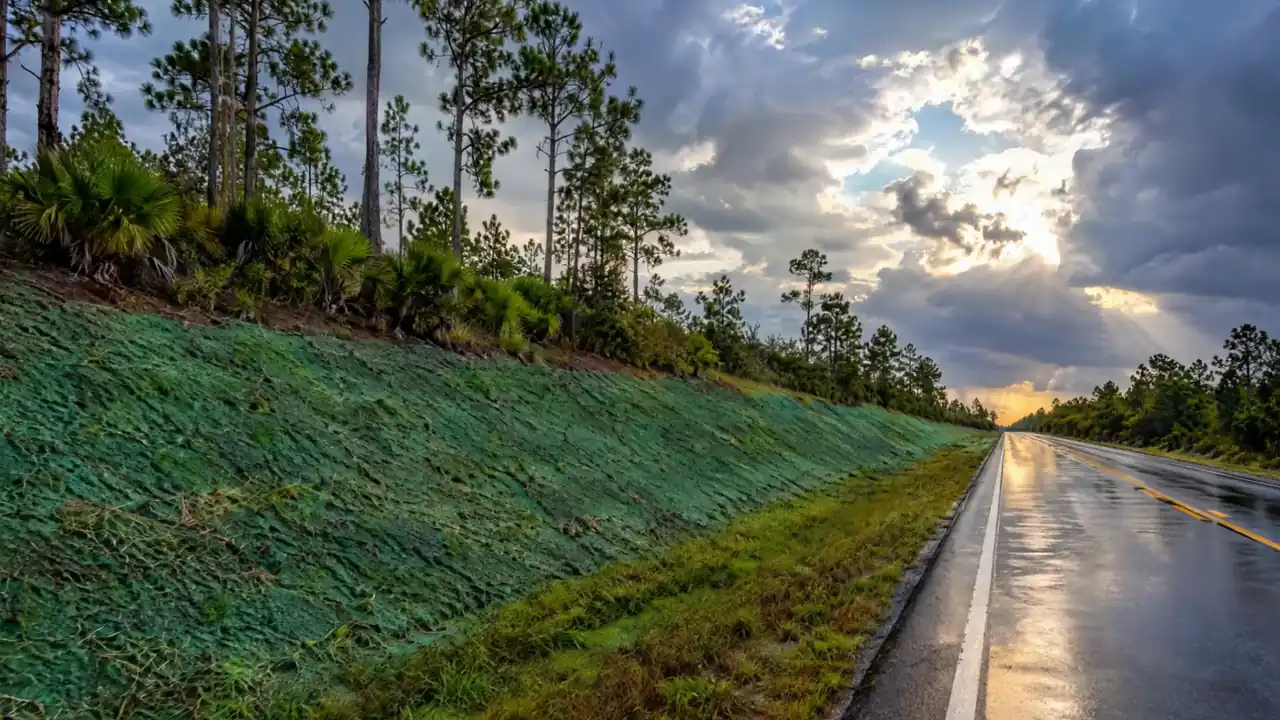
One continuous layer, no gaps
FDOT requires bonded fiber matrix to cover 100 percent of the surface, hold together when re-wetted and form no water-repelling crust.
Seasons and seed under BFM
BFM is a cover, not a grass. The permanent result still depends on seed and season. In the April to early July window we seed bahia, common bermuda or a seasonal mix under or with the matrix. Late in the year, when the UF/FDOT roadside guide advises against seeding warm-season grasses, BFM or hydromulch with annual ryegrass protects the ground through winter, and permanent seed goes in during spring. Our seeding calendar shows the timing.
What BFM costs
There is no reliable public per-acre price for BFM. Industry sources describe it as applied heavily, on the order of 3,000 to 4,000 pounds per acre on moderate slopes, and costing more per acre than standard hydromulch. For comparison, Stormwater magazine lists blanket material at roughly $0.35 to $0.50 per square yard for single-net straw, $0.50 to $0.80 for wood fiber and $0.80 to $1.05 for double-net coir, before installation. Because slope, access and area drive BFM cost, we quote each job after a site visit. General pricing is on our hydroseeding cost page.
Common questions about bonded fiber matrix and hydromulch
Short, sourced answers to what people ask us most. If your site has a wrinkle these do not cover, send it through the quote form below and we will talk it through with you.
What is bonded fiber matrix?
Bonded fiber matrix, or BFM, is a hydraulically applied erosion-control product: fibers held together by a water-resistant bonding agent that form a continuous layer over the soil. FDOT accepts it in place of seed, hydroseed or sod outside designated sod areas, and requires it to be fully biodegradable and form no water-repelling crust.
What is the difference between hydromulch and BFM?
Hydromulch is loose hydraulic mulch, with or without seed, that protects exposed soil temporarily. BFM adds a water-resistant bonding agent so the fibers form one continuous mat that does not dissolve when re-wetted. BFM costs more per acre and is used on steeper, stable slopes where hydromulch could wash.
When should I use an erosion blanket instead of BFM?
Where water concentrates. Ditch bottoms, swale inverts, outfalls and stream crossings carry flowing water that a sprayed layer is not mechanically anchored against, so staked straw, wood-fiber or coir blankets are the usual choice. BFM fits slope faces that are steep but stable and receive rain rather than channel flow.
Can BFM be used on any slope?
No. FDOT Section 570 limits bonded fiber matrix to geotechnically stable slopes. If a slope is slumping, sliding or undercut, it has to be regraded or structurally reinforced before any erosion cover goes on. BFM protects the surface from erosion; it does not hold up an unstable slope.
How much does bonded fiber matrix cost?
There is no reliable published per-acre price. BFM is applied at heavy rates, commonly cited at about 3,000 to 4,000 pounds per acre on moderate slopes, and costs more per acre than standard hydromulch. Slope, access and area drive the price, so we quote each job after seeing the site.
Keep reading
Related guides and services for sandy soil, heavy rain and the grasses that hold on the Gulf Coast, each written for Escambia and Santa Rosa county sites.
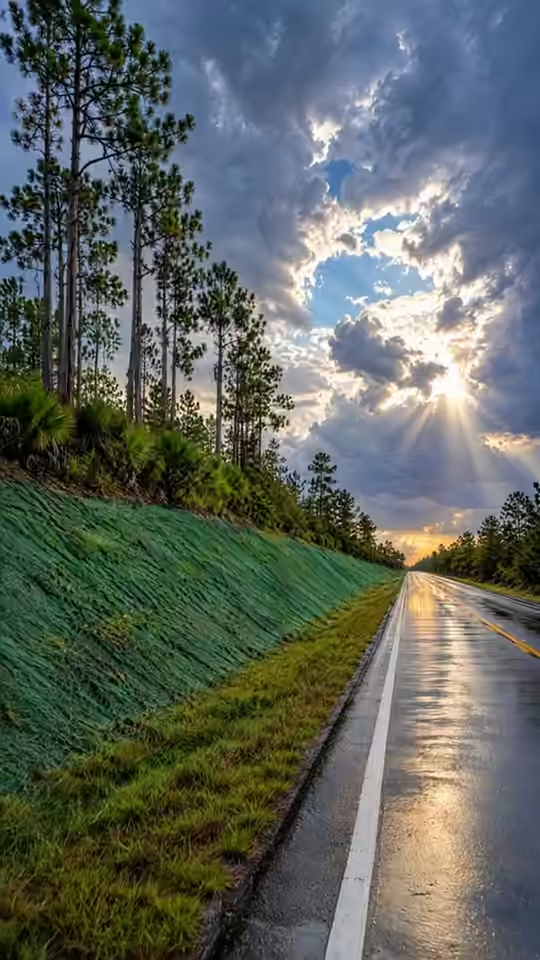
Erosion Control
Hydromulch, bonded fiber matrix, blankets and temporary grass for slopes, ditches and bare ground in one of the rainiest cities in the country.
Open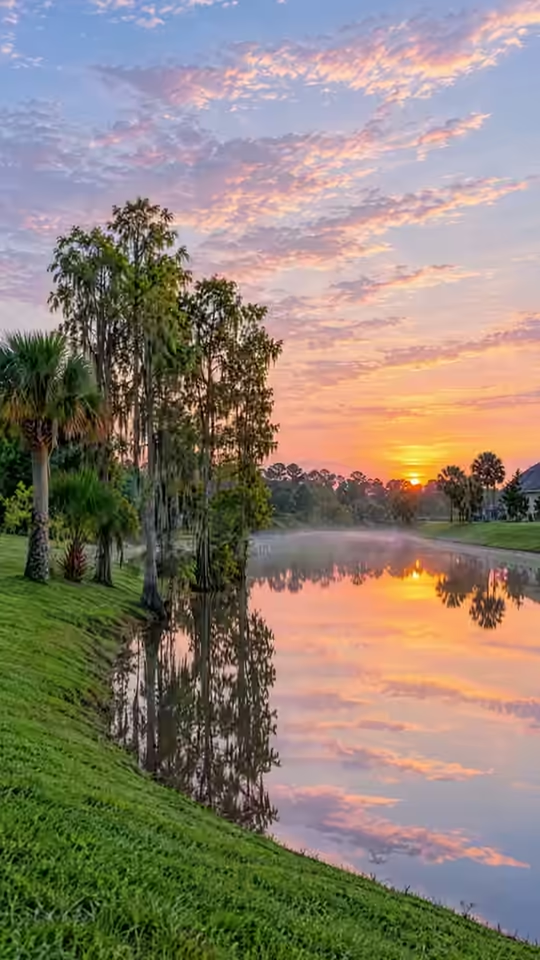
Pond Bank and Retention Pond Hydroseeding
Retention and detention pond banks, roadside ditches and swales, regraded where needed and seeded with grass that fits wet toes and dry crests.
Open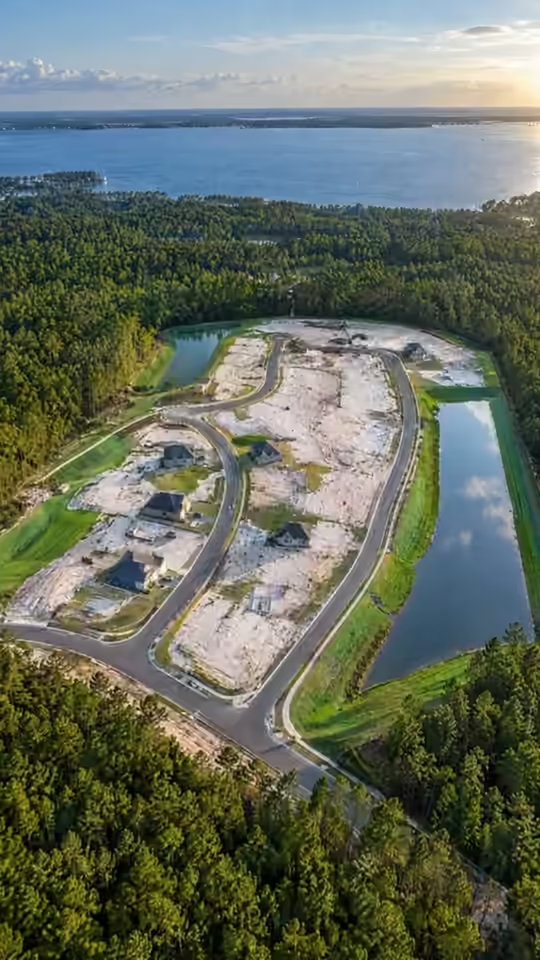
Final Stabilization and 70% Cover in Florida
Getting a permitted site to 70 percent uniform perennial cover so the Notice of Termination can be filed, with seed mixes timed to the season.
OpenCommercial Hydroseeding and NW Florida
Subdivisions, commercial pads, HOA common areas, solar fields and right-of-way, with the planting scope coordinated around site conditions, access and the project schedule.
Open
Hydroseeding cost: price ranges
Published local and national ranges, what they leave out, and the site conditions that push a Pensacola job up or down the scale.
OpenSources
Facts on this page come from public sources, mostly UF/IFAS Extension, the Florida Department of Environmental Protection, FDOT and NOAA. We recheck them whenever we update the page.
- FDOT Standard Specifications Section 570, Performance Turf
- Bonded Fibre Matrix (overview)
- EPA National Menu of Construction BMPs
- Stormwater magazine: Cost-effective erosion control with blankets and mats
- UF/FDOT, A Guide for Roadside Vegetation Management (2012)
- Florida DEP NPDES Construction Generic Permit, 62-621.300(4)(a)
Tell us about the ground
Send the address and what you are trying to grow or hold in place. We look at the site, the soil and the slope, then quote the mix and the method that fit it.